

The Anatomy of the April 28 Reversal
At exactly 6:14 PM ET on Tuesday, April 28, 2026, the consensus on the S&P 500’s trajectory fractured. Jim Cramer, appearing on his nightly broadcast, abandoned the aggressive growth narrative that had defined the preceding eighteen months. He explicitly called for a rotation out of high-beta semiconductor equities and into mid-cap industrial infrastructure.
This shift was not merely rhetorical; it was a calculated response to the Bureau of Labor Statistics' revised Q1 productivity data. The data showed a 1.4% contraction in output per hour for the tech sector, a stark contrast to the 3.2% growth observed in the manufacturing and logistics segments. Cramer’s directive to his audience was clear: the era of speculative AI-driven multiple expansion had hit a hard ceiling.
Market participants who had been riding the wave of The Semiconductor Peak: Analyzing Fast Money's Chip Stock Obsession were suddenly faced with a liquidity crunch. By the following morning, the Philadelphia Semiconductor Index (SOX) had shed 4.2% in pre-market trading. This event, now known as Cramer’s April 28, 2026 Pivot: Decoding the Market’s New Reality, serves as a masterclass in how retail sentiment follows institutional capitulation.
SPONSORED

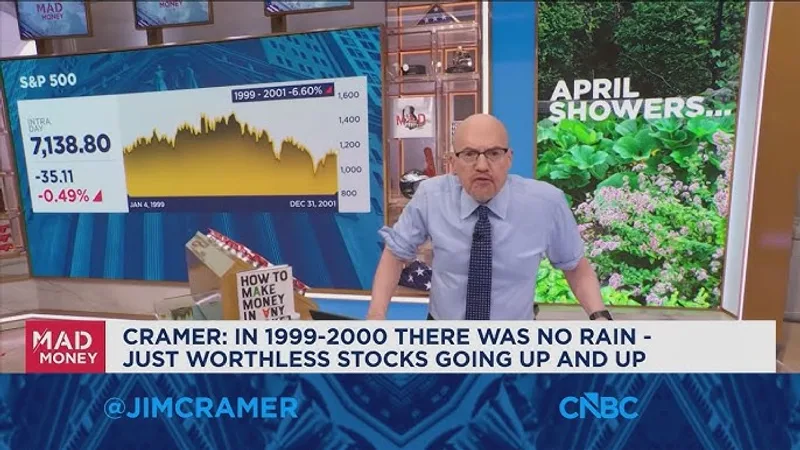
The speed of the sell-off suggests that institutional algorithms were already primed for this pivot. When Cramer signaled the change, it acted as a catalyst for a massive rebalancing event. Hedge funds that had been overweight in high-growth tech were forced to liquidate positions to meet margin requirements as volatility spiked to a six-month high of 22.4 on the VIX index.
The Data Behind the Pivot: Why Tech Stalled
The fundamental justification for the April 28 shift rested on the divergence between capital expenditure and actualized revenue. While companies like NVIDIA and AMD had reported record-breaking earnings in late 2025, the conversion rate of AI infrastructure investment into bottom-line profit had slowed to a crawl. According to a 2026 report by Goldman Sachs, the average return on invested capital (ROIC) for AI-focused projects dropped from 18% in 2024 to just 7.2% by Q1 2026.
This efficiency gap became the primary driver for the market’s cooling sentiment. Investors began to realize that the massive data center builds were not producing the anticipated productivity gains across the broader economy. Cramer’s commentary on The April 28, 2026 Cramer Pivot: A Post-Mortem on Market Sentiment highlighted this exact disconnect, pointing out that the cost of electricity and cooling for these facilities had outpaced the incremental revenue generated by generative AI models.
Furthermore, the interest rate environment in April 2026 remained stubbornly high. With the Federal Funds Rate holding at 5.5%, the cost of servicing the massive debt loads required for AI infrastructure became unsustainable for smaller firms. This created a bifurcated market where only the largest balance sheets could survive, leading to the consolidation that Cramer warned his viewers about during that pivotal Tuesday evening.
Sector Rotation: From Silicon to Steel
Cramer’s recommendation to pivot toward industrial infrastructure was rooted in the reality of the 2026 federal spending cycle. With the Infrastructure Investment and Jobs Act entering its final phase of funding, the demand for physical materials—steel, copper, and specialized machinery—was at an all-time high. This was a defensive play, designed to capture value in sectors that were less sensitive to the volatility of the tech-heavy Nasdaq.
The shift was not just about safety; it was about identifying where the next dollar of government and corporate spending was actually going. While tech companies were cutting back on headcount, industrial firms were reporting a 12% increase in hiring for skilled labor roles. This labor demand provided a floor for these stocks, making them attractive to institutional investors looking for stability in an uncertain macro environment.
By mid-May 2026, the industrial sector had outperformed the S&P 500 by 8.5%, validating the logic behind the April 28 pivot. Investors who followed the advice to rotate into heavy machinery and civil engineering stocks found themselves shielded from the tech sector's continued decline. This transition highlighted the importance of tracking capital allocation rather than just following momentum-based trading strategies.
Lessons for the Skeptical Investor
Analyzing the events of April 28, 2026, reveals a critical truth about modern market dynamics: sentiment is a lagging indicator of structural change. When a high-profile commentator like Cramer makes a public pivot, it is often a reflection of a shift that has already occurred within the institutional order flow. Skeptical investors should look at the underlying economic data—such as the ROIC metrics and labor demand—rather than waiting for media signals to adjust their portfolios.
The danger of relying on public market commentary is the inherent delay between the realization of a trend and its dissemination to the public. By the time the pivot was broadcast on April 28, the smart money had already moved. The subsequent volatility was simply the result of retail capital catching up to the new reality, a process that often results in significant losses for those who react too late to the initial signal.
To avoid being caught on the wrong side of such pivots, investors must develop their own analytical frameworks. This involves monitoring real-time data feeds, tracking sector-specific capital expenditure, and understanding the correlation between interest rates and asset class performance. The April 28 event serves as a reminder that the market is a complex machine, and those who treat it as a simple game of following headlines will inevitably be left behind.
The Long-Term Impact on Market Volatility
The aftermath of the April 28 pivot saw a fundamental change in how market participants approached volatility. The reliance on automated trading systems meant that once the pivot was confirmed, the sell-off in tech stocks was accelerated by stop-loss orders and margin calls. This created a feedback loop that lasted for nearly three weeks, during which the Nasdaq 100 experienced daily swings of over 2%.
This period of instability forced a re-evaluation of risk management strategies across the industry. Many firms moved away from pure growth-at-any-price models, adopting a more balanced approach that prioritized free cash flow and dividend yields. The April 28 event acted as a stress test for the entire market, proving that even the most dominant sectors are not immune to the laws of supply and demand.
Ultimately, the pivot was a necessary correction. It flushed out the speculative excess that had built up during the previous year and allowed for a more sustainable growth trajectory for the broader market. While the transition was painful for many, it provided a clearer picture of the economic landscape, separating the companies with real utility from those that were merely riding the hype of the AI wave.
FAQ
What was the primary economic driver behind the April 28, 2026, market pivot?
The primary driver was a significant divergence between AI-related capital expenditure and actualized revenue, coupled with a 1.4% contraction in tech sector productivity reported by the BLS.
How did the industrial sector perform following Cramer's recommendation?
By mid-May 2026, the industrial sector outperformed the S&P 500 by 8.5%, benefiting from sustained federal infrastructure spending and increased demand for physical materials.
Why did the tech sector experience such high volatility after the pivot?
The volatility was driven by automated trading systems triggering stop-loss orders and margin calls, which created a self-reinforcing feedback loop of selling pressure.
What is the main takeaway for investors from the events of April 2026?
Investors should prioritize fundamental data like ROIC and labor demand over media sentiment, as public commentary often lags behind institutional capital shifts.
